4 Teen Anxiety Signs That Also Show Up With Too Little Sleep
Quick Answer
Watching your teen struggle is hard. Irritability, poor focus, constant tiredness and outsized worry can signal anxiety or too little sleep, so check school-night sleep first.
Ignoring mental health issues can also be detrimental. Singer-songwriter Katelyn Tarver, speaking on the Check Your Head podcast in 2021, described it: "I put off therapy for years because I was like, well, I'm fine. I'm just having a moody week."
Sleep is the simpler place to start. Rest will not fix everything, though, and a moody week that keeps returning once your teen's nights get longer is when I would bring in a counselor.
In the CDC's 2021 Youth Risk Behavior Survey, more than 29% of high schoolers said their mental health was poor most of the time or always during the past 30 days. Some of that distress is anxiety. Teen sleep author Lisa L. Lewis, who cited that survey on the Diverse Thinking Different Learning podcast in 2024, said that sleep deprivation worsens both anxiety and depression, and that teens feel it more sharply because the prefrontal cortex, the part of the brain that handles impulse control, has not fully matured.
Anxiety does not always look the way parents expect, either. Singer-songwriter Katelyn Tarver, speaking on the Check Your Head podcast in 2021, once tied anxiety only to panic attacks: "It's like I have panic attacks, which means I can't breathe. So I wasn't relating anxiety to any of those." Naming the quieter habit of spiraling into worst-case scenarios helped: "that's not just a bad day. That is a form of anxiety."
Short sleep can hide in plain sight too. Sullivan + Associates Clinical Psychology describes a split pattern many teens fall into: as little as 4 to 5 hours at night, a tired school day, 3 to 4 more hours of sleep after school, then a late bedtime all over again. Even when the hours add up, the practice warns, the sleep stays inconsistent and leads to the same problems.
One problem can exacerbate the other. One forum commenter, recalling childhood bedtimes, wrote that "what gave me anxiety was having to lay there in the dark, alone, not sleepy, and then my thoughts would get really out of control and the anxiety would make me panic." Paul Weigle, MD, a child and adolescent psychiatrist, wrote in STAT in 2025 that many depressed youths value late-night screen entertainment because it brings "temporary relief" from their daily distress, which is why I would ask what the phone is doing for your teen at midnight before asking them to hand it over.
Watching your teen snap over small things, drift through homework or lie awake worrying is hard, and it is natural to wonder whether anxiety is the cause. A teen who cannot fall asleep early is not being lazy or stubborn, since, as teen sleep author Lisa L. Lewis said in 2024, "it's because of biology." Lewis adds that the teenage brain is going through a multi-year pruning phase, a reshaping that stretches into the early 20s and takes place primarily during sleep, and that once it is complete young people can focus their attention more effectively, act less impulsively and make better decisions.
Teen sleep runs on a different clock. According to AFMC, puberty delays the release of melatonin, the brain chemical that signals it is time to sleep, by approximately two hours, so many teens do not feel tired until around 11 p.m. or later. Screens push bedtime later still. A 2021 Common Sense Media report found that 13- to 18-year-olds spend almost nine hours a day looking at screens, and blue light from phones, tablets and computers suppresses melatonin. The American Academy of Pediatrics recommends that middle and high schools start no earlier than 8:30 a.m., yet many districts still ring the first bell earlier.
The American Academy of Sleep Medicine describes healthy sleep as more than a count of hours: it also needs sensible timing, good quality, regularity and freedom from sleep disorders. I would like every teen-anxiety sign list to ask about those things before it asks about worry.
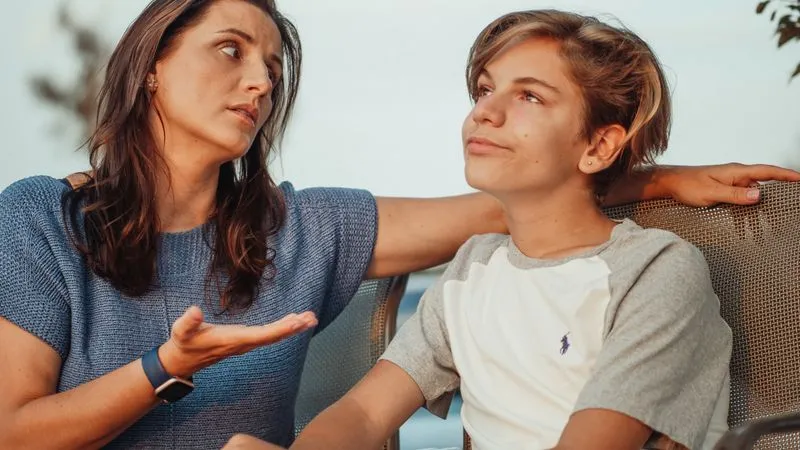
Which teen anxiety signs also show up with too little sleep?
Four signs overlap most: irritability and mood swings, trouble focusing, constant tiredness with aches or headaches, and worry that feels bigger than the situation. Each can follow short sleep.
In 2025, AFMC reported CDC data showing that more than 75% of high school students miss the recommended 8 hours of sleep on school nights. The same review tied chronic sleep deprivation in adolescents to higher risks of mood disorders, including depression and anxiety, and to attention deficits and slower reaction times. Lost sleep can even produce anxiety on its own, as one poster on an anxiety forum described: "Whenever I'm awake for too long, I get anxiety, even though I have nothing to feel anxious about."
Before you hold your teen up against any sign list, I'd suggest gathering a little information first. For a couple of weeks, notice:
- What time your teen actually falls asleep and wakes up on school nights.
- Which days a sign shows up, and whether those days follow a late night.
- Whether the sign softens after a night of full rest.
- Whether the worry keeps returning to the same specific fear, however rested your teen is.
Irritability and mood swings
The National Sleep Foundation reported in 2024 that regularly disrupted sleep is associated with more mood swings, irritability, and increased emotional reactivity. Emotional reactivity is how quickly and strongly a person reacts to small frustrations. A teen who snaps over a lost charger may be anxious. They may also be running on empty.
Trouble focusing and remembering
The same NSF report notes that insufficient sleep may lead to difficulties with problem-solving, decision-making, concentration, and retaining information. Poor focus is easy to blame on a worried mind. A tired brain produces the same picture.
Constant tiredness, aches and headaches
Physical complaints are where the confusion runs deepest. A 16-year-old posting on an online mental health forum traced months of lost sleep to late-night iPad and iPhone use, then wrote: "I haven't felt well rested in a year. I am constantly tired." The same poster described how "the past few weeks my eyes have been feeling strained, and I've been having a nearly 24/7 headache." One forum commenter replied, "You mention some symptoms that a doctor might diagnose as anxiety or depression."
Fatigue, a heavy tiredness that daytime rest does not fix, is exactly the kind of sign that can point in either direction.
Worry that feels bigger than the situation
That same teen wrote, "everything stresses me out, I tend to see everything as a chore." The NSF article adds that when people sleep poorly, they are more likely to read the world around them in a negative light. The arrow also points the other way. AFMC names the anxiety caused by cramming schoolwork as one of the forces behind chronic teen sleep delay, so worry and short nights can feed each other for weeks before anyone names either one.
A sign list cannot reliably sort anxiety from ordinary teen stress, because each of these four signs can look the same whether its root is worry, a string of short nights, or both. A sign on a list is a starting point, not a verdict.
If you would like help sorting out what you are seeing, our team offers free consultations so you can decide whether we are a good therapeutic match, and you can call 469-238-2686 to get started. You can also read how therapy for teens in Frisco works with our team.
How common is teen sleep loss compared with teen anxiety disorders?
Short sleep is more common than an anxiety disorder in teens. How many hours did your teen actually sleep on the last five school nights?
In 2025, Paul Weigle, MD, a child and adolescent psychiatrist writing in STAT, cited National Science Foundation figures showing that 70% of American high school students get less than eight hours of sleep per night. He added that two-thirds of adolescents fail to get the minimum eight hours on most school nights. His point about awareness may matter even more to parents: "Teens and their parents often fail to connect an onset of depression and anxiety with a decline in their sleep habits."
Anxiety disorders are common as well. An anxiety disorder is anxiety that is excessive and lasting enough to interfere with daily life, such as school work and relationships. The National Institute of Mental Health estimates that 31.9% of adolescents aged 13 to 18 had any anxiety disorder at some point in their lives, and that 8.3% of those had severe impairment. Girls were affected more often than boys, at 38.0% versus 26.1%.
Those numbers have limits. The NIMH estimates rest on a national survey fielded from 2001 to 2004 under an older diagnostic manual, DSM-IV, which still counted post-traumatic stress disorder and obsessive-compulsive disorder as anxiety disorders. They also count a whole lifetime, while the sleep figures describe ordinary school nights, so the two cannot be lined up neatly side by side.
When I weigh them anyway, anxiety is clearly not rare. Short nights are not spread evenly, either: Weigle notes that Black and male teens sleep the least. Sleep loss is also the easier problem to test at home.
The evidence points both ways. Reported in 2025 by teen sleep writer Lisa L. Lewis, a meta-analysis of 73 studies found that when teens didn't get enough sleep, their odds of feeling depressed rose by 62 percent. That finding concerns depression rather than anxiety, but she describes the same loop with anxious feelings: feeling anxious or overwhelmed makes a good night's sleep harder to reach, and sleeping poorly intensifies those feelings. Sullivan + Associates Clinical Psychology warns that sleeping less than 7 hours can increase the risk of behavioral problems by 50%, "and it gets worse from there."
These findings report correlation rather than causation. However, the connection between short sleep and a teen's emotional health is strong enough to take seriously.
On a hard morning, it helps to ask: did my teen sleep enough last night, and would this worry still be here if they had? If you are already wondering about an assessment, you can read about therapy for anxiety in Frisco with our team while you watch how your teen's late nights line up with their hardest days.
What did we find when we lined up the sleep and anxiety numbers?
When your teen is snapping, drifting and worrying all at once, you want to understand what is happening. We lined up the national sleep and anxiety numbers.
The National Institute of Mental Health estimates that 31.9% of U.S. adolescents aged 13 to 18 had any anxiety disorder, based on a national survey of 10,123 teens carried out from 2001 to 2004 (NIMH). The count is generous. It covers a disorder at any point in a teen's life, and it used the older DSM-IV criteria, which still put post-traumatic stress disorder and obsessive-compulsive disorder in the anxiety category. The current DSM-5 no longer does. An estimated 8.3% of the teens it counted had severe impairment.
Every sleep estimate we found notes that teens are short on sleep, with 8 hours being the minimum amount of sleep required. Eight hours is the very bottom of the 8 to 10 hours per 24 hours that the American Academy of Sleep Medicine recommends for ages 13 to 18 (AASM, 2016).
The surveys come from different decades and ask different questions, so the bars cannot give the odds for your own teen. Still, the most broad anxiety estimate sits well below the most cautious sleep estimate, and the sleep figures describe an ordinary school night.
Families also often miss the connection. "Teens and their parents often fail to connect an onset of depression and anxiety with a decline in their sleep habits," writes Paul Weigle, MD, a child and adolescent psychiatrist with 25 years of treating young people (STAT, 2025).
One reason is that each problem feeds the other. The Victorian Government's Better Health Channel describes how "the habit of lying awake and worrying" interferes with sleep, and also warns that too little sleep makes a teen's brain more active: "An over-aroused brain is less able to fall asleep." Lisa L. Lewis, a writer and speaker on teen sleep, puts it this way: "Feeling anxious, overwhelmed or hopeless can make it hard to get a good night's sleep. And, of course, not sleeping well intensifies what we're feeling." A short night never means your teen's worry is imaginary.
Catch-up sleep is a separate issue. Weigle notes that sleep-deprived teens more often "nap after school and crash on the weekend, temporarily meeting their sleep debt but failing to undo most of the related damage." The sources do not all agree on how strict to be. The Better Health Channel tells parents to "Allow your child to sleep in on the weekends" and to encourage after-school naps if time allows. It also tells teens that "Late nights will undo your hard work." Where the guidance does agree is regularity. The AASM panel writes that healthy sleep "requires adequate duration, appropriate timing, good quality, regularity," and Joe DiMaggio Children's Hospital passes along CDC advice to keep the same schedule on weekdays and weekends (JDCH, 2024).
About six weeks
Even 30 minutes of extra sleep each night, kept up regularly, makes a big difference, says the Better Health Channel. However, "it may take about six weeks of getting extra sleep before you feel the benefits." A weekend of sleeping in cannot consistently create that change. Aim for longer stretches during the school nights instead.
One finding limits how long anyone should wait. Insufficient sleep in teenagers "is associated with increased risk of self-harm, suicidal thoughts, and suicide attempts," the AASM panel concluded after reviewing 864 published articles. Lewis cites research finding that teens who sleep less than six hours a night are more than three times more likely to report considering or attempting suicide than teens who sleep at least eight. These studies report correlation rather than causation. However, the connection between sleep and safety is powerful, and a sleep check should never delay care when a teen talks about self-harm.
Seen side by side, the numbers suggest short sleep is a more common explanation than an anxiety disorder for a tired, irritable, worried teen, though they come from different surveys and cannot be compared directly. The loop between sleep and worry means that sleep alone cannot rule anxiety out. If the signs ease after weeks of steady rest, sleep was likely a big part of the picture. If they stay, or worry keeps your teen awake whatever the bedtime, that is a clearer reason to talk with a therapist.
- Count school nights only, and measure them against 8 hours, the bottom of the range recommended for teens.
- Leave weekend sleep-ins and long after-school naps out of the count, and ask how many school nights in a row reach 8 hours.
- Give steady extra sleep about six weeks before judging whether the irritability and worry have changed.
- Ask your teen what keeps them awake: a screen, homework, or thoughts they cannot switch off.
- If your teen mentions self-harm, reach out to a therapist right away, whatever the sleep picture.
How we checked this
We used federal statistics from NIMH, an American Academy of Sleep Medicine consensus statement, guidance from the National Sleep Foundation, the Better Health Channel, Joe DiMaggio Children's Hospital and AFMC, an essay by a child and adolescent psychiatrist, and a newsletter by a teen sleep writer. None of the figures in this section come from our own practice. The anxiety estimate comes from a survey carried out 2001 to 2004 under older criteria. The NSF page does not say which year its 80% poll comes from. We read the 70% figure and the figure of more than 75% secondhand. The Better Health Channel page was last reviewed in 2018. Joe DiMaggio Children's Hospital promotes its own sleep medicine services, Lisa L. Lewis books talks on teen sleep, and we offer teen counseling, so each of us has a stake. Still unknown: how many short-sleeping teens also have an anxiety disorder, and how often worry fades once sleep improves. None of our sources measured that directly.
- National Institute of Mental Health, statistics on any anxiety disorder, survey data 2001 to 2004.
- Paul Weigle, MD, STAT essay on teen sleep loss and mental health, June 2025.
- AFMC, article on teen sleep deprivation, April 2025.
- National Sleep Foundation, article on teen sleep and mental health, March 2024.
- Joe DiMaggio Children's Hospital, blog post on teen sleep hygiene, June 2024.
- Better Health Channel, Victorian Government, teenagers and sleep guidance, last reviewed May 2018.
- American Academy of Sleep Medicine, consensus statement on sleep for children and teens, Journal of Clinical Sleep Medicine, November 2016.
- Lisa L. Lewis, MS, newsletter on the sleep and mental health connection, May 2025.
How can you check sleep first, and when should your teen see a therapist?
Check school-night sleep against what teens actually need, give more rest a fair trial, and call a therapist when signs persist, worsen, or include any talk of self-harm.
Before you count hours, look at what fills your teen's evenings, since the Victorian Government's Better Health Channel names homework, sport, part-time work and social commitments among the after-school demands that eat into sleep time. Where one of those can give a little, I would let sleep have that time for a few weeks. Then watch what remains. As a licensed professional counselor-supervisor and certified school counselor, my advice to parents is to make sleep the first thing you look at, not the last.
What does a sleep check at home involve?
- Measure against the right target. In 2016, the American Academy of Sleep Medicine issued a consensus statement, drawn from a panel review of 864 published articles, recommending that teenagers 13 to 18 sleep 8 to 10 hours per 24 hours on a regular basis. Teen sleep author Lisa L. Lewis said in 2024 that younger teens need more, at 9 to 11 hours a night until they turn 14.
- Compare the target with real nights. The Victorian Government's Better Health Channel notes that most adolescents get only about 6.5 to 7.5 hours a night, and some get less. For a stretch of school nights, jot down bedtime, wake time and how the next day went: mood, focus, headaches and worry.
- Change one thing, together. In a study by VicHealth and the Sleep Health Foundation, teens who put down their smartphones an hour before bed gained an extra 21 minutes of sleep a night, or 1 hour and 45 minutes over the school week. Talk it over with your teen and brainstorm the plan side by side. Announcing a new household rule is rarely a successful approach with older teens.
- Give it time. Better Health Channel says even 30 minutes of extra sleep each night can make a big difference, yet the benefits may take about six weeks to be felt. To move a late body clock, keep the same bedtime routine for at least four weeks, then start it 10 minutes earlier each week until your teen reaches the target bedtime.
An eight-hour night can still leave a 13-year-old short. Sleep debt builds quietly. One guard against it is simple: set your home Wi-Fi to switch off automatically each evening. If your teen's irritability and headaches fade as the nights lengthen, sleep was likely part of the cause. If they hold steady through weeks of better rest, that points toward something else worth looking into.
When is it time to call a therapist?
Sleep is only where the check starts. Better Health Channel describes a vicious circle in which too little sleep makes a teenager's brain more active, and an over-aroused brain is less able to fall asleep, so a sleep plan that never gets off the ground can be a sign in itself. I would reach out for support when:
- worry, irritability or poor focus stay the same after several weeks of better sleep
- worry keeps your teen awake however early the lights go out
- the signs get in the way of school, friendships or family life
- home changes add no sleep at all, in which case your teen's doctor can also check for sleep disorders such as sleep apnea or restless legs syndrome
One sign should never wait for a sleep trial. The American Academy of Sleep Medicine's consensus statement also found that insufficient sleep in teenagers is associated with increased risk of self-harm, suicidal thoughts and suicide attempts. The panel reports correlation rather than causation, yet the connection still matters: a badly underslept teen deserves a closer look, not just a bedtime talk. If your teen talks about suicide or self-harm, call or text 988 to reach the 988 Suicide & Crisis Lifeline right away, or go to the nearest emergency room if they are in immediate danger.
If you decide to reach out, bring your notes on bedtimes, wake times and hard days with you, since they give a therapist a concrete place to begin the conversation. Our team offers free consultations so your family can decide whether we are a good therapeutic match, and you can call our office at 469-238-2686 to get started. Our therapists take most major insurances, but your independent benefits determine your specific payment per session. When you call, we can tell you about your specific plan, and if we cannot accommodate you, we refer you to community partners that take your insurance. If you would like to know what that first conversation covers, the questions people ask before they call are a good place to start.
Why should sleep come first when a teen seems anxious?
Sleep loss and anxiety produce many of the same signs, so checking sleep first protects teens from a hasty label while still catching the worry that needs care.
I expect sleep to move from an afterthought to the first question in teen anxiety assessments. The overlap makes the case on its own: irritability, poor focus, fatigue and outsized worry sit on both lists, and AFMC reported in 2025, citing CDC data, that more than 75% of high school students fail to get the recommended 8 hours of sleep on school nights. The same AFMC article urged pediatricians and sleep specialists to reframe adolescent sleep "from one of discipline to one of recognition, acknowledgment, and support." I welcome that shift.
A fair question is whether your teen's age explains what you are seeing. In the National Comorbidity Survey Adolescent Supplement, a face-to-face survey of 10,123 teens, the share with any anxiety disorder barely changed with age: 31.4% at ages 13 to 14, 32.1% at 15 to 16 and 32.3% at 17 to 18. Age alone does not sort the worried teen from the tired one. Sleep, tracked gently over several weeks, can tell you more.
Start the sleep log tonight. Keep it curious rather than critical, and give extra rest a fair trial. If the worry stays once your teen is rested, our team offers free consultations so your family can decide whether we are a good therapeutic match, and you can reach our office at 469-238-2686.
Tonight, you might simply ask your teen what time they would like to be asleep, and build the plan from their answer.
Summarize This Article With AI
Open this article in your preferred AI engine for an instant summary.
Frequently Asked Questions
What else do parents ask about teen anxiety and sleep?
Common questions cover telling sleep debt from anxiety, helping teens wind down, and starting care when worry stays after rest improves.
How can I tell whether my teen is sleep deprived or anxious?
Sleep-deprived teens often nap after school, crash on weekends and sometimes doze off in class. Those habits point toward sleep debt. Anxiety tends to stay put even after several weeks of fuller nights, so I find it helps to notice which signs fade as sleep improves and which ones do not.
Can anxiety cause sleep problems in teens?
Yes. Worry can keep a teen awake, and the lost sleep can then make the worry harder to manage. Insomnia, ongoing trouble falling or staying asleep, is one of several problems that may call for a formal sleep study, along with sleep apnea, restless legs syndrome and delayed sleep-wake phase disorder, a body clock that runs much later than a teen's schedule allows.
What helps a teen wind down before bed?
An Arkansas Foundation for Medical Care (AFMC) article on teen sleep recommends putting screens away 30 to 60 minutes before sleep, keeping the bedroom cool, dark and quiet, and skipping caffeine, sugar and heavy meals late in the evening. Teen sleep author Lisa L. Lewis suggests a consistent wind-down routine, such as a bath, yoga, coloring or a podcast. Charging phones outside the bedroom overnight removes one more pull. Build the routine with your teen, not for them.
Should my teen see a sleep specialist or a therapist?
Sometimes both. If sleep problems persist despite good habits, a board-certified sleep specialist can check for a sleep disorder. If worry, irritability or poor focus remain once sleep improves, a therapist can help your family understand what is driving them. Our team offers free consultations so you can decide whether we are a good therapeutic match, and you can call 469-238-2686 to get started.
Can too little sleep raise the risk of depression as well?
The American Academy of Sleep Medicine's expert panel links insufficient sleep with a higher risk of depression, along with accidents and injuries. That finding reports correlation rather than causation, but the connection still matters for a teen who already seems low. If your teen's mood has dropped along with their sleep, therapy for depression is one option worth talking through. If your teen mentions suicide or self-harm, call or text 988 to reach the 988 Suicide & Crisis Lifeline.
Do your therapists take insurance?
Our therapists take most major insurances, but your independent benefits determine your specific payment per session. Our licensed professional counselor associates can take your insurance too. Call 469-238-2686 and we can tell you about your specific plan, and if we cannot accommodate you, we refer you to community partners that take your insurance.
How soon can my teen be seen, and are after-school or online sessions available?
We work very hard to see new clients the same week they reach out, or the following week. We offer evening and after-school appointments, with in-person counseling in Frisco and telehealth therapy across Texas, so sessions can fit around the school day.
Written by
Bonnie King
PhD, LPC-S, CSC
Bonnie King, PhD, LPC-S, CSC, has practiced as a counselor since 2010, working with children, adults, and teens with a variety of mental health concerns, including trauma, mood disorders, and specific concerns related to LGBTQ+ marginalization.
Connect on LinkedIn